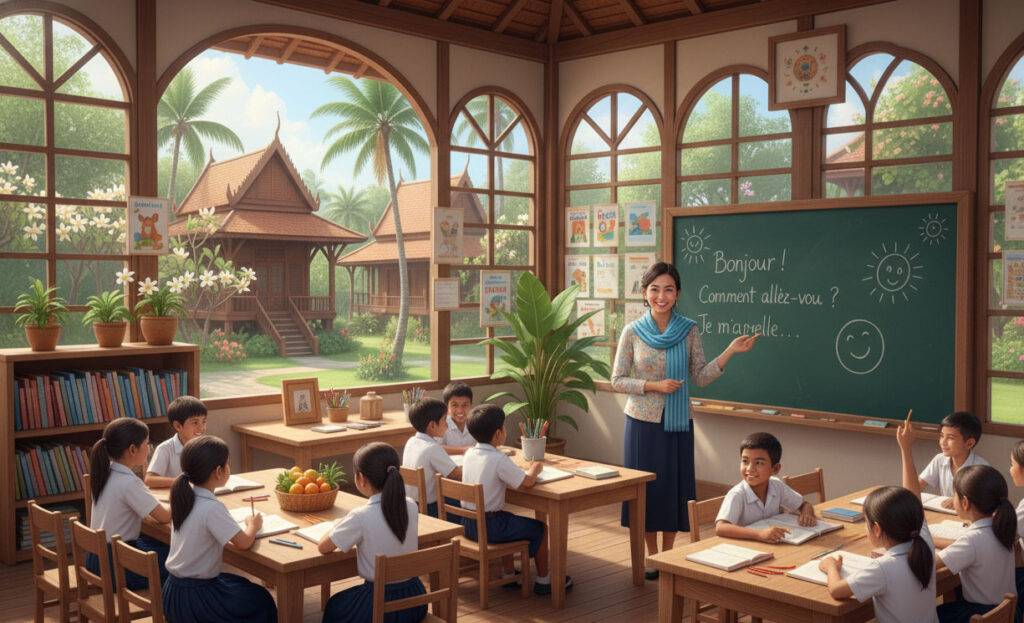
Learning French in Cambodia has never been easier. Whether you want to speak with locals, travel confidently, or explore new opportunities, this full practical course will guide you step by step. From essential greetings and daily conversations to useful phrases for shopping, transportation, and dining, you’ll gain the skills you need to communicate effectively in French.
This course is completely free and designed for beginners who want to start speaking French right away. Each lesson is focused on practical usage, with clear examples, pronunciation tips, and exercises you can apply in real life in Cambodia.
By the end of this course, you’ll be able to hold simple conversations, understand basic French, and feel confident using your new language skills in everyday situations. Let’s get started!
Table of Contents
Lesson 1: Greetings and Basic Phrases
Start speaking French from day one. Learn essential phrases for daily life.
| French | English | Pronunciation |
|---|---|---|
| Bonjour | Hello / Good morning | bon-zhoor |
| Bonsoir | Good evening | bon-swahr |
| Salut | Hi / Bye | sa-lu |
| Merci | Thank you | mehr-see |
| Merci beaucoup | Thank you very much | mehr-see boo-koo |
| S’il vous plaît | Please | seel voo pleh |
| Excusez-moi | Excuse me | ex-kew-zay mwah |
| Comment ça va ? | How are you? | koh-mahn sa va |
| Ça va bien | I’m fine | sa va byan |
| Au revoir | Goodbye | oh ruh-vwahr |
Practice: Use these phrases every day in shops, markets, or cafes in Cambodia.
Lesson 2: Numbers and Counting
Numbers are essential for shopping, telling time, and transportation.
| French | English | Pronunciation |
|---|---|---|
| 0 – zéro | 0 – zero | zay-ro |
| 1 – un | 1 – one | uh(n) |
| 2 – deux | 2 – two | duh |
| 3 – trois | 3 – three | twa |
| 4 – quatre | 4 – four | katr |
| 5 – cinq | 5 – five | sank |
| 6 – six | 6 – six | sees |
| 7 – sept | 7 – seven | set |
| 8 – huit | 8 – eight | weet |
| 9 – neuf | 9 – nine | nuf |
| 10 – dix | 10 – ten | dees |
Practice: Count your steps, money, or items at the market to memorize numbers.
Lesson 3: Introductions and Asking Questions
Learn to introduce yourself and ask simple questions.
| French | English | Pronunciation |
|---|---|---|
| Je m’appelle [name] | My name is [name] | zhuh ma-pell [name] |
| Enchanté(e) | Nice to meet you | ahn-shan-tay |
| Où est… ? | Where is…? | oo eh…? |
| Combien ça coûte ? | How much is it? | kohm-byen sa koot |
| Parlez-vous anglais ? | Do you speak English? | par-ley voo ahn-glay? |
| Je ne comprends pas | I don’t understand | zhuh nuh kom-prahnd pah |
Practice: Introduce yourself to locals, try asking directions in French, and respond politely.
Lesson 4: Food and Restaurants
Essential phrases for eating out or shopping at markets.
| French | English | Pronunciation |
|---|---|---|
| Je voudrais… | I would like… | zhuh voo-dray |
| L’addition, s’il vous plaît | The bill, please | la-dee-syon seel voo pleh |
| Un café | A coffee | uh(n) ka-fay |
| Un thé | A tea | uh(n) tay |
| De l’eau | Water | duh lo |
| Pain | Bread | pan |
| Poulet | Chicken | poo-lay |
| Riz | Rice | ree |
| Légumes | Vegetables | lay-goom |
Practice: Order food in French at local cafés or markets to reinforce vocabulary.
Lesson 5: Directions and Transportation
Travel confidently around Cambodia using French.
| French | English | Pronunciation |
|---|---|---|
| À gauche | To the left | ah gosh |
| À droite | To the right | ah drwat |
| Tout droit | Straight ahead | too drwah |
| Où est la gare ? | Where is the station? | oo eh la gar? |
| Un taxi | A taxi | uh(n) tak-see |
| Un bus | A bus | uh(n) boos |
| L’aéroport | Airport | la-air-oh-por |
Practice: Ask for directions in French when navigating Phnom Penh, Siem Reap, or Sihanoukville.
Lesson 6: Shopping and Bargaining
Key phrases for shopping in markets, stores, or tourist areas.
| French | English | Pronunciation |
|---|---|---|
| Combien ça coûte ? | How much is it? | kohm-byen sa koot |
| C’est trop cher | It’s too expensive | say tro shair |
| Pouvez-vous baisser le prix ? | Can you lower the price? | poo-veh voo beh-say luh pree? |
| Je voudrais acheter… | I would like to buy… | zhuh voo-dray ash-tay |
| Où puis-je trouver… ? | Where can I find…? | oo pwee-zh troo-vay |
Practice: Try bargaining in French at local markets for souvenirs or clothes.
Lesson 7: Daily Life and Common Expressions
| French | English | Pronunciation |
|---|---|---|
| Il fait chaud | It’s hot | eel feh sho |
| Il fait froid | It’s cold | eel feh frwah |
| Je suis fatigué(e) | I am tired | zhuh swee fa-tee-gay |
| J’ai faim | I’m hungry | zhay fam |
| J’ai soif | I’m thirsty | zhay swahf |
| C’est magnifique | It’s beautiful | say ma-nee-feek |
| Très bien | Very good | tray byan |
| Pas mal | Not bad | pah mal |
Practice: Use these phrases in conversation with friends, locals, or classmates.
Lesson 8: Grammar Essentials
- Articles: le (masculine), la (feminine), les (plural)
- Verbs “être” and “avoir”:
- Je suis / Tu es / Il est (I am / You are / He is)
- J’ai / Tu as / Il a (I have / You have / He has)
- Simple sentence structure: Subject + Verb + Object
- Example: Je mange du riz → I eat rice
Practice: Write 5 sentences daily using new verbs and vocabulary.
Lesson 9: Listening and Speaking
- Listen to French podcasts, songs, or YouTube lessons.
- Repeat phrases aloud to improve pronunciation.
- Join French language meetups or online groups in Cambodia.
Practice: Record yourself speaking and compare to native pronunciation.
Lesson 10: Putting It All Together
- Start conversations with locals using greetings and questions.
- Go shopping, order food, and ask for directions in French.
- Practice daily: 15–30 minutes is enough to see progress in weeks.
Tip: Keep a small notebook with new words and phrases. Review it every day.
✅ This course covers basic French speaking, listening, reading, and writing, tailored for people living or traveling in Cambodia. If you follow it consistently, you will gain confidence in daily interactions and be able to navigate markets, cafes, and public places in French.